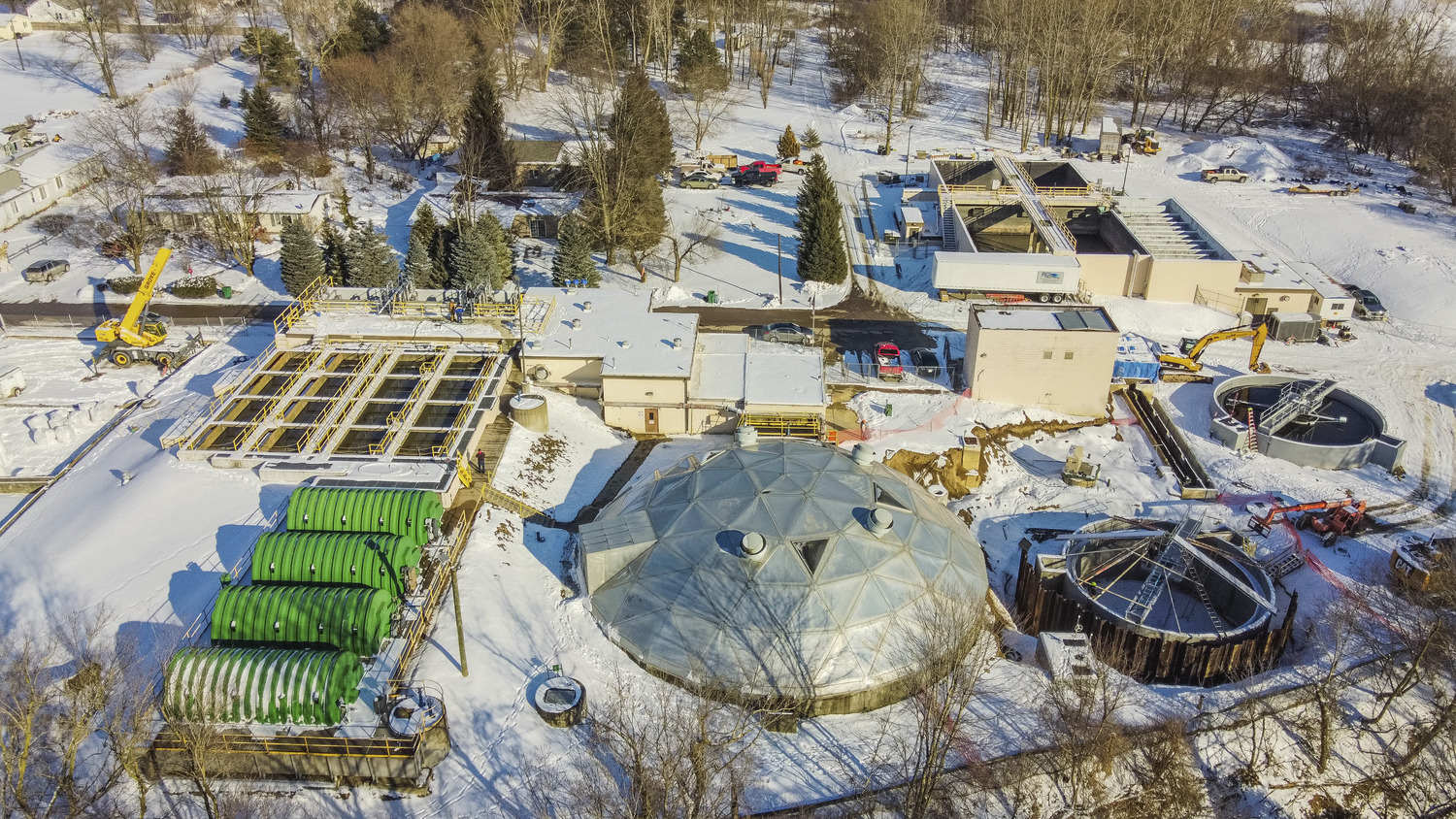
Increasing Capacity, Efficiency, and Savings
Project Highlights
- Emergency retrofit of failing flat-plate MBR membrane trains
- Conversion to hollow fiber membrane technology under active plant conditions
- Installation of new ejectors, air compressors, and blowers
- Integration of new membrane train with existing control systems
- Reuse of existing piping to maintain hydraulic profile during construction
- Continuous compliance with NPDES effluent limits throughout upgrades
- 2025 ACEC/M Engineering Merit Award recipient
Project Summary
The Leoni Township Wastewater Treatment Plant (WWTP) provides sewage disposal services to 13 communities, which comprise the Leoni Regional Utility Authority (LRUA). Members of the LRUA are the Townships of Leoni, Napoleon, Columbia, Norvell, Hanover, and Liberty, the Charter Townships of Blackman and Grass Lake, and the Villages of Grass Lake and Brooklyn as well as Cambridge Township, in Lenawee County, and the Townships of Sylvan and Lyndon in Washtenaw County.
In 2010, the WWTP underwent major improvements that included abandoning the lagoon treatment system and constructing a mechanical membrane bioreactor (MBR) WWTP to meet the more stringent effluent limits of their National Pollutant Discharge Elimination System (NPDES) permit.
The municipal wastewater delivered to the plant was within the hydraulic and load projections of the initial design. However, from 2016 to 2019 the five flat-plate type MBR trains began to gradually lose hydraulic performance and required extensive maintenance just to process typical average daily flows. Fleis & VandenBrink (F&V) was in the process of designing a new hollow fiber type MBR system for the WWTP; however, disaster struck when four of the five membrane trains all but failed, causing the need for an emergency replacement and repair. An emergency solution to modify one flat plate MBR train to accept the hollow fiber type until full replacement could occur was developed to restore capacity and keep the plant operational until the full improvements could be implemented. This was challenging as flat plate membranes work by gravity and hollow fiber works under suction.
To address the emergency, we retrofitted the flat plate membrane system with a hollow fiber membrane technology. This upgrade involved installing two new ejectors, air compressors, and blowers. A major challenge – and innovation – was integrating the new hollow fibers train with the existing controls systems while reusing the existing piping to maintain the hydraulic profile during construction. This approach enabled the plant to remain operational, provide essential hydraulic capacity, and meet effluent limits throughout the construction process.
AWARDS
- 2025 ACEC/M Engineering Merit Award

Tell Us About Your Project
Start a conversation with our design team. We’ll help you turn your vision into a buildable, fundable project.