Newsletter: Federal-Aid Grant Applications for Rural Projects Happening Now

Applications open next month for Indiana rural communities seeking federal grants for new bridge, road, safety, sidewalk or any type of project that is eligible under the federal transportation highway bill (FAST ACT).
The Indiana Department of Transportation (INDOT) will be accepting applications, starting November 2. The call for projects closes on December 11.
The City of Montpelier is expected to be among the applicants for the Federal Highway Administration (FHWA) funding via INDOT. It received federal reimbursement grants in the past for a sign inventory project, sidewalk replacement/American Disabilities Act (ADA) ramp upgrade and a sign replacement project in 2016.
“None of these federal grants would have been possible without the help of our engineering consultant,” said Jeff Clouse, Montpelier’s street superintendent. “We are a small rural community and our operating budgets do not allow for many projects without some kind of grant opportunity attached to them.”
Local Public Agency (LPA) projects are available for funding with projects to be bid in the 2026 fiscal year. The table below shows some guidelines:
Bridge Projects
Replacement (sufficiency rating < 50)
Rehabilitation (sufficiency rating < 80)
Removal
Replacement of low water crossings
Road Reconstruction Projects
Group 3 (Cities with 5,000 to 50,000 population)
Group 4 (County or Town under 5,000 population)
Transportation Alternative Program Projects
Trails
Safe Routes to Schools (SRTS)
ADA sidewalk upgrades
Safety Projects
Sign & guardrail replacement
Intersection improvement
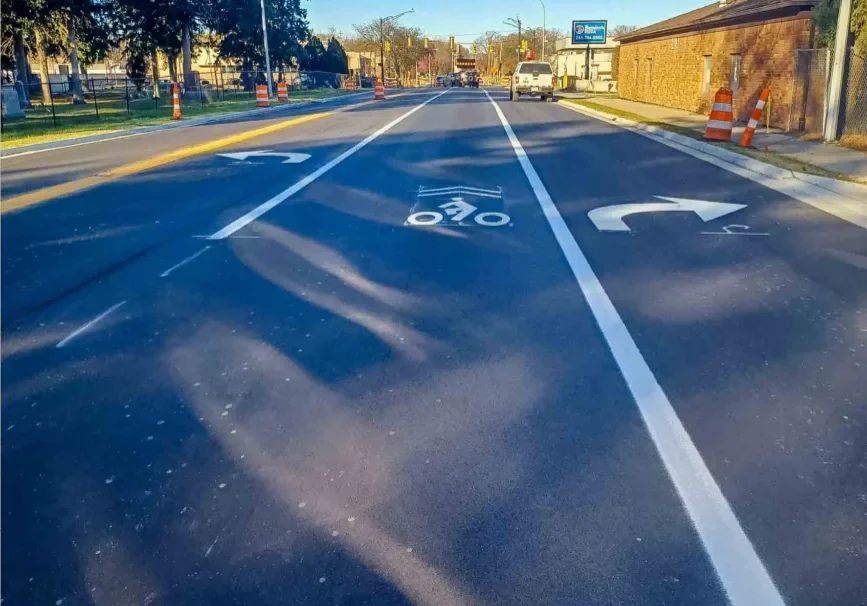
Pavement markings
F&V can help with detailed requirements
Many supporting documents are required in addition to the online project application. They include a financial commitment letter on the LPA’s letterhead, signed by the fiduciary body of the LPA and an ADA/Title VI commitment letter. The ADA/Title VI document is required to ensure that all sub-recipients of federal funds administered by INDOT are following those requirements.
For a bridge project, the latest bridge inspection is required. Bridges must be rated as a 4 or less. New Bridges and INDOT bridges are not eligible.
For Highway Safety Improvement Program (HSIP) funding, the HSIP application for systemic work must also be completed.
For road or bridge preventative maintenance, communities are required to submit their asset management plan. Road projects must also be on the Federal Highway System which classifies roads as either all arterials (rural or urban) or all urban collectors and rural major collectors.
A well-defined scope of work and a detailed independent cost estimate prepared by the LPA is needed. Current traffic counts and crash data are also required.
The City of Montpelier used a consultant for grant application and the preliminary engineering and design work including utility coordination.
“I strongly encourage other cities and towns to contact a consultant to see what federal grant opportunities are available for them,” Clouse said. “The grant process is detail-oriented and it’s not an easy application.
“Our consultant helped walk us through the federal bureaucracy and all the red tape that comes with these federal projects.”
If you need help understanding INDOT requirements or would like assistance in completing an application for INDOT funding, contact Troy Stahl at 800.494.5202 or 317.797.4428.
You can reach us today at any one of our 11 locations.
Related Posts