How Road Commissions Decide Which Roads Get Fixed
Everyone has a road like this. Maybe it’s the one you drive daily that rattles the change out of the cupholder, or the one with the patch that failed three winters ago, or the one you have already brought up at a township meeting twice. Then spring arrives, the orange barrels come out, and the crews set up somewhere else entirely.
From the driver’s seat it can look arbitrary, though it seldom is. Michigan road agencies operate within a set of rules that determine how much money is available, which roads that money is allowed to touch, and what sort of repair the pavement will support, and nearly all of it is decided long before anyone picks up a shovel. Often, the worst road in a county is frequently among the last to get attention, for reasons that have more to do with how pavement fails than with anyone ignoring the complaints.
On This Page
Whose Road Is It?
A surprising number of road complaints land at the wrong agency, which is an easy mistake to make, since nothing about a road announces who owns it.
Michigan roads fall into four groups:
- State trunklines. Anything numbered I-, US-, or M- belongs to the Michigan Department of Transportation (MDOT).
- County primary and county local roads. These belong to the county road commission, and Michigan has 83 of them.
- City and village streets. Cities and villages own and maintain their own major and local streets, even where those streets sit inside a county.
- Private roads. Subdivision and association roads carry no public maintenance obligation.
Jurisdiction can change at a city limit sign or, less helpfully, halfway down a block. The same stretch of pavement might be a county road for half a mile and a city street for the quarter mile after that. Most road commissions and public works departments publish a jurisdiction map, and it is worth a look before you make the call, because the wrong agency can only give you a polite redirect.
How Road Condition Is Measured
Michigan does not judge road condition by feel. It uses PASER (short for Pavement Surface Evaluation and Rating), a system developed at the University of Wisconsin-Madison Transportation Information Center, in which raters drive the road and score the surface from 1 to 10 based on the type and extent of visible distress. The Transportation Asset Management Council (TAMC) then collapses those scores into three categories: 1 through 4 is poor, 5 through 7 is fair, and 8 through 10 is good.
The data collection is more organized than most residents assume. Three-person teams made up of an MDOT representative, a regional or metropolitan planning representative, and a local agency representative rate at least half of the paved federal-aid system each year, with over 100 teams covering roughly 86,000 lane miles on a two-year cycle.
What matters for planning is that a PASER score points toward a treatment rather than functioning as a report card. A road at 8 or 9 needs crack sealing and routine maintenance; a road at 5 or 6 is a candidate for a seal coat or a thin overlay; and a road at 2 or 3 has structural problems that only rehabilitation or full reconstruction will resolve. The same road can produce three different projects at three very different prices, depending entirely on when it gets caught.
Where Michigan Road Money Comes From
The County Road Association of Michigan (CRA) puts the 2026 breakdown at 49% fuel tax, 29% vehicle registration fees, 12% corporate income tax, 7% wholesale marijuana tax, 2% retail marijuana tax, and 1% miscellaneous and interest earnings. Fuel tax and registration fees are the traditional pair. The corporate income tax and marijuana tax shares arrived with the 2025 transportation funding package, and the CRA expects the mix to keep shifting annually through 2030.
Two developments explain most of that change. The Legislature exempted motor fuel from the state sales tax and replaced it with an equivalent increase in the fuel tax rate, which sent money already collected at the pump to roads instead of the general fund. It also created a 24% wholesale tax on marijuana, effective January 1, 2026, and earmarked a share of corporate income tax revenue for roads.
Both of the newer sources are less predictable than a fuel tax. The wholesale marijuana tax faces an ongoing constitutional challenge from the marijuana industry, early collections have come in below projection, and the corporate income tax earmark only reaches roads after the first $1.25 billion in corporate income tax revenue is collected for other purposes. Agencies that build a five-year program around money that may or may not arrive tend to get burned, so many of them budget the newer revenue conservatively until it shows up.
The Money Is Spoken For Before Anyone Picks a Road
Most people assume a road commission can aim its budget wherever the pavement is worst. In practice, the money arrives labeled, and it now arrives through two separate channels.
Fuel taxes and registration fees flow into the Michigan Transportation Fund, which is governed by Public Act 51 of 1951. After several allocations off the top, the Michigan Transportation Fund splits 39.1% to the state trunkline fund, 39.1% across the 83 county road commissions, and 21.8% across cities and villages.
The county share is then divided among those 83 agencies by a second formula built on road miles, population, and vehicle registration taxes attributable to the county, with registration taxes carrying almost half the weight. A county’s slice of state road money, therefore, tracks how many vehicles are registered within its borders rather than the condition of its roads.
Corporate income tax and marijuana tax revenue take the other channel. Public Act 16 of 2025 amended Act 51 to create the Neighborhood Roads Fund, which reserves money for local bridges and grade separation projects before distributing the balance to county road commissions, cities and villages, and the state trunkline fund. The distribution mechanism is new enough that agencies are still working out what it means for their annual programs.
Federal aid adds another constraint, since federal dollars can only be spent on federal-aid-eligible roads, a category that excludes most subdivision streets and a large share of county local roads. The neighborhood street breaking apart at the edges may sit outside every federal program, which leaves it competing for the smallest slice of the local budget.
Competitive programs come with rules of their own. Safety money through the Highway Safety Improvement Program follows crash data, so a road needs a documented crash history to qualify, and Surface Transportation Program dollars carry eligibility limits of their own. For many agencies, local millages and special assessments are the only flexible funding on the books.
Why the Worst Road Isn’t First
Pavement does not decline in a straight line, which is where intuition starts to fail. A road holds up reasonably well for years and then falls off a cliff, because once water works its way into the base, deterioration accelerates fast. Timing, as a result, drives cost more than severity does.
The Michigan Senate Fiscal Agency has put numbers to it: one dollar spent on capital preventive maintenance while a road is still in fair condition can delay or prevent six to fourteen dollars of reconstruction on that same road once it degrades to poor. Industry analysis in Michigan puts reconstruction at five to eight times the per-lane-mile cost of preventive treatment.
Apply that to a budget and the strategy explains itself. An agency that spends its construction season rebuilding one failed road has consumed what might have preserved a long list of roads still sitting at 5 and 6, and those roads then slide into poor condition and join the reconstruction queue behind it. A few years of that and the list of expensive rebuilds grows faster than the funding ever will.
Agencies that keep their networks in decent shape spend a large share of their money on roads that still look fine, which is exactly the behavior residents find maddening: crews sealing a street that “wasn’t even bad” while the bad one waits another year.
None of this means poor roads never get rebuilt, and a working program needs a mix of treatments spread across the network. But an agency that chases the worst road first will run out of money before it runs out of worst roads.
What Else Moves a Road Up the List
- Crash history: Safety money follows documented crash patterns rather than general concern, so a dangerous-feeling road with no reported crashes has a harder case to make.
- Traffic volume and truck routes: Heavy commercial traffic breaks pavement faster, and those segments tend to move up.
- School bus and emergency response routes: Agencies weight the roads that ambulances, fire apparatus, and buses depend on.
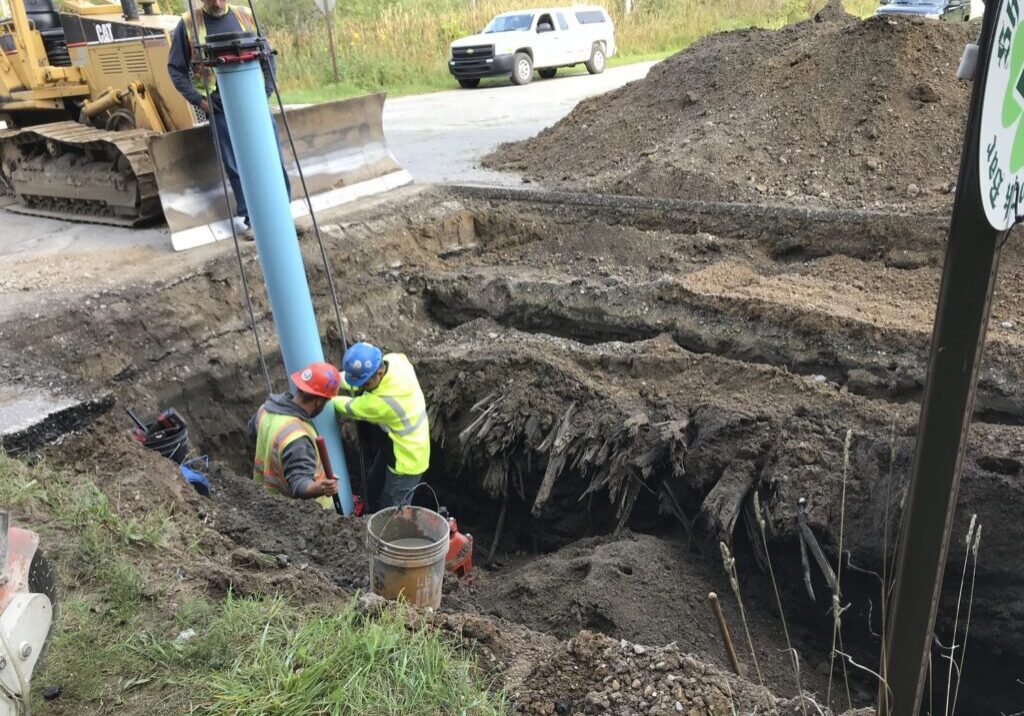
- What is buried underneath: Nobody wants to resurface a road sitting on top of a 90-year-old watermain that is due for replacement, so utility condition frequently drives sequencing, and a road can wait years for the pipe work to get funded first.
- Drainage and culverts: Standing water and failing culverts are often the cause of pavement failure rather than a symptom of it, and fixing the surface without addressing the drainage buys at most three years.
- Coordination with neighboring work: An MDOT project, an adjacent city’s paving schedule, or a county drain project can pull a road forward or push it back so detour routes stay usable.
- Grant timing: A road that fits an open funding cycle may move ahead of a road in worse shape that does not.
The Plan Behind the Decisions
Since 2018, this process has been written into state law. Public Act 325 obligates every road agency with 100 or more certified miles to submit a Transportation Asset Management Plan to the TAMC on a three-year cycle, which covers all 83 county road commissions along with a long list of cities. The plan documents current condition, sets condition goals, and lays out a multi-year capital program.
Those obligations have teeth. Agencies that fail to submit a plan or to show progress toward the condition goals in the plan they submitted face restrictions on their Act 51 funding. So when a resident asks a road commission why a particular road is not on the list, there is a document somewhere with the answer, and asking to see it is a reasonable request.
How This Works in Indiana
Instead of road commissions, Indiana counties operate highway departments under the county commissioners, alongside city and town street departments, and local road money flows primarily through Motor Vehicle Highway and Local Road and Street distributions.
The larger difference is Community Crossings. In addition to federal funds that are available to municipalities and counties through INDOT, since 2016, INDOT’s matching grant program has become the main source of construction dollars for many local agencies, and it will not accept an application from a community without a current INDOT-approved asset management plan. Any project submitted has to already appear in that plan. The match runs 80/20 for counties with populations under 55,000 and cities/towns with populations under 12,500. For larger counties, cities, and towns, the match is 50/50.
PASER also appears on the Indiana side, with training delivered through the Local Technical Assistance Program. Rate the pavement, write the plan, choose the treatment the rating supports, then go after the match. The acronyms change at the state line; the sequence does not.
What to Ask Your Road Agency
If a road matters to you, these questions will get you further than a complaint will:
- Who has jurisdiction over this road?
- What is its current PASER rating, and when was it last rated?
- What treatment does that rating support?
- Where does it sit in the multi-year capital program?
- What share of the budget goes to preservation versus reconstruction, and what condition mix is the agency targeting network-wide?
Every one of these has an answer. An agency running a functioning program can produce it without much trouble, and an agency that cannot is telling you something about its planning that is worth raising at a public meeting.
For the People on the Other Side of the Question
Road and county commissioners, county engineers, city engineers, and council members field these questions constantly, and defending a priority list gets considerably easier when the data behind it is current and the plan is written down. That case is harder to make in a year when the revenue side is still settling.
That is usually where things break down. Ratings age out, as-built records get filed somewhere and forgotten, and then a project starts, and nobody can say with certainty what is under the road.
Fleis & VandenBrink (F&V) works with county and municipal road agencies across Michigan and Indiana on pavement management and resurfacing programs, asset management and capital improvement planning, roadway and intersection design, bridge and culvert coordination, drainage design, Local Agency Program project management with MDOT, and Local Public Agency (LPA) projects managed through INDOT. Our team also assists with funding applications through MTF, HSIP, and STP, and provides construction administration and inspection through the build.
Once construction wraps, our GIS staff collect and upload the new asset data so the record reflects what is in the ground, which helps the next planning cycle move faster than the last.
Talk with our transportation team about your next program.
Frequently Asked Questions
Where does Michigan road funding come from?
The County Road Association of Michigan puts the 2026 breakdown at 49% fuel tax, 29% vehicle registration fees, 12% corporate income tax, 7% wholesale marijuana tax, 2% retail marijuana tax, and 1% miscellaneous and interest earnings. The corporate income tax and marijuana tax shares are new as of the 2025 transportation funding package, and the mix is expected to change each year through 2030.
Why do road agencies fix roads that look fine?
Preventive treatments on roads in fair condition cost a fraction of the cost of reconstruction after those same roads fail. Michigan Senate Fiscal Agency figures put the difference at roughly six to fourteen dollars of future reconstruction avoided for every dollar of preventive maintenance, so spreading a budget across preservation keeps more of the network out of the expensive category.
What is a PASER rating?
PASER is a 1-to-10 pavement condition scale based on visual inspection. Michigan’s Transportation Asset Management Council groups 1 through 4 as poor, 5 through 7 as fair, and 8 through 10 as good. Ratings on the federal-aid system are collected by trained three-person teams and published publicly.
Can I find out my road’s condition rating?
Often, yes. TAMC publishes statewide condition data, and many regional planning organizations post interactive PASER maps for their counties. Your county road commission or city public works department can also tell you when a given segment was last rated.
Why can’t the county just move money to the worst roads?
Most road funding arrives with restrictions attached. Act 51 distributes money by formula rather than by need, federal aid is limited to federal-aid-eligible roads, and competitive programs carry their own eligibility rules. Local millages are frequently the only flexible funding an agency controls.
Who do I contact about a particular road?
It depends on jurisdiction. State trunklines go to MDOT, county primary and local roads go to the county road commission, and city and village streets go to that municipality. Private subdivision roads are the association’s responsibility.
You can reach us today at any one of our 11 locations.
Related Posts